The U-Curve of Happiness: Why Midlife Feels Hard—and Why the Best May Still Be Ahead
There’s a pattern that shows up again and again in research on human happiness.
It’s called the U-Curve of Happiness.
And if you’re a woman somewhere in the middle of your life—feeling restless, dissatisfied, or wondering “Is this it?”—this pattern might explain a great deal.
Not because something has gone wrong.
But because something very natural may be unfolding.

The Surprising Shape of a Human Life
Researchers Graham and Milena Nikolova analyzed global survey data from 149 countries in which people rated their lives on a scale from 0 (the worst possible life) to 10 (the best possible life).
What they found was striking.
In 80 countries, life satisfaction followed a consistent pattern.
It formed a U-shape.
Happiness tends to:
• Start relatively high in youth
• Gradually decline through the 30s and 40s
• Reach its lowest point somewhere between ages 39 and 57
• Then rise again through the 50s, 60s, and even 70s
The average low point? Around age 50.
In other words:
The struggle many people feel in midlife is not a personal failure.
It’s a statistically common stage of life.

Why Midlife Feels So Heavy
Researchers believe midlife can feel particularly difficult because several forces converge at once.
One study found middle-aged adults experience a kind of double whammy:
• Life satisfaction is declining
• Expectations are declining even faster
That combination can leave people feeling both disappointed and pessimistic.
Many women in midlife are also juggling:
• Career pressure
• Parenting responsibilities
• Caring for aging parents
• Health or hormonal changes
• Questions about purpose and identity
Add in the cultural narrative that life peaks early and then declines—and it’s easy to see how women can start wondering if the best chapters are already behind them.
But the science tells a different story.

Why Happiness Often Rises After 50
Across many studies, life satisfaction begins rising again in the 50s and beyond.
Why?
Researchers suggest several fascinating shifts occur as people age.
1. Priorities Clarify
Psychologist Laura Carstensen explains that as time horizons grow shorter, people begin investing more intentionally in what truly matters.
Instead of chasing status or comparison, they focus on:
• meaningful relationships
• purpose
• emotional connection
• experiences that actually nourish them
2. Expectations Become More Realistic
When expectations settle into something more grounded, reality begins to exceed them more often.
Positive surprises increase.
Life begins to feel lighter.

3. Wisdom and Emotional Skills Grow
Research suggests that with age:
• social reasoning improves
• long-term decision making strengthens
• comfort with uncertainty increases
• spirituality deepens (especially among women)
Many older adults also show greater emotional regulation and less impulsivity.
In other words, the brain itself becomes better at life.
4. The Brain Adapts
Psychiatrist Dilip Jeste and colleagues have found that older adults often compensate for decline in some brain regions by recruiting additional neural networks in others.
This increased neuroplasticity can support emotional wisdom and resilience.
So while aging brings certain challenges, it can also bring unexpected strengths.

A Transition, Not a Downward Spiral
The U-Curve suggests something important.
Midlife is not the beginning of the end.
It’s a recalibration point.
A transition.
A time when many women naturally begin shifting from:
• competition → connection
• proving → meaning
• striving → aligning
In other words, midlife often marks the moment when a woman begins asking deeper questions:
What actually matters to me now?
What kind of life do I want to create next?
Those questions can feel unsettling.
But they are also the doorway to the next phase of life.

When Biology Joins the Conversation
For women, this transition is even more profound because it coincides with real biological shifts.
During perimenopause and menopause:
• hormone levels fluctuate dramatically
• sleep can change
• stress responses may increase
• mood regulation may feel less stable
Your body, brain, and nervous system are literally rewiring themselves.
So if midlife has felt emotionally intense or confusing, it may help to know that what you're experiencing is both psychological and biological.
Your system is recalibrating.
And many women find that once this transition settles, something remarkable happens:
A deeper clarity begins to emerge.

Seeing the Forest Instead of the Trees
One of the hardest things about midlife is that when you're in it, you’re often standing inside the thickest part of the forest.
The path is harder to see.
But zoom out far enough and the shape of the journey becomes clearer.
The U-Curve reminds us that the middle of life isn’t a collapse.
It’s a valley that leads to a rise.
And many women report that their 50s, 60s, and beyond become some of the most meaningful years of their lives.
Not because life suddenly becomes easy.
But because they finally start living it on their own terms.

A Simple Tool for Tracking Your Happiness Over Time
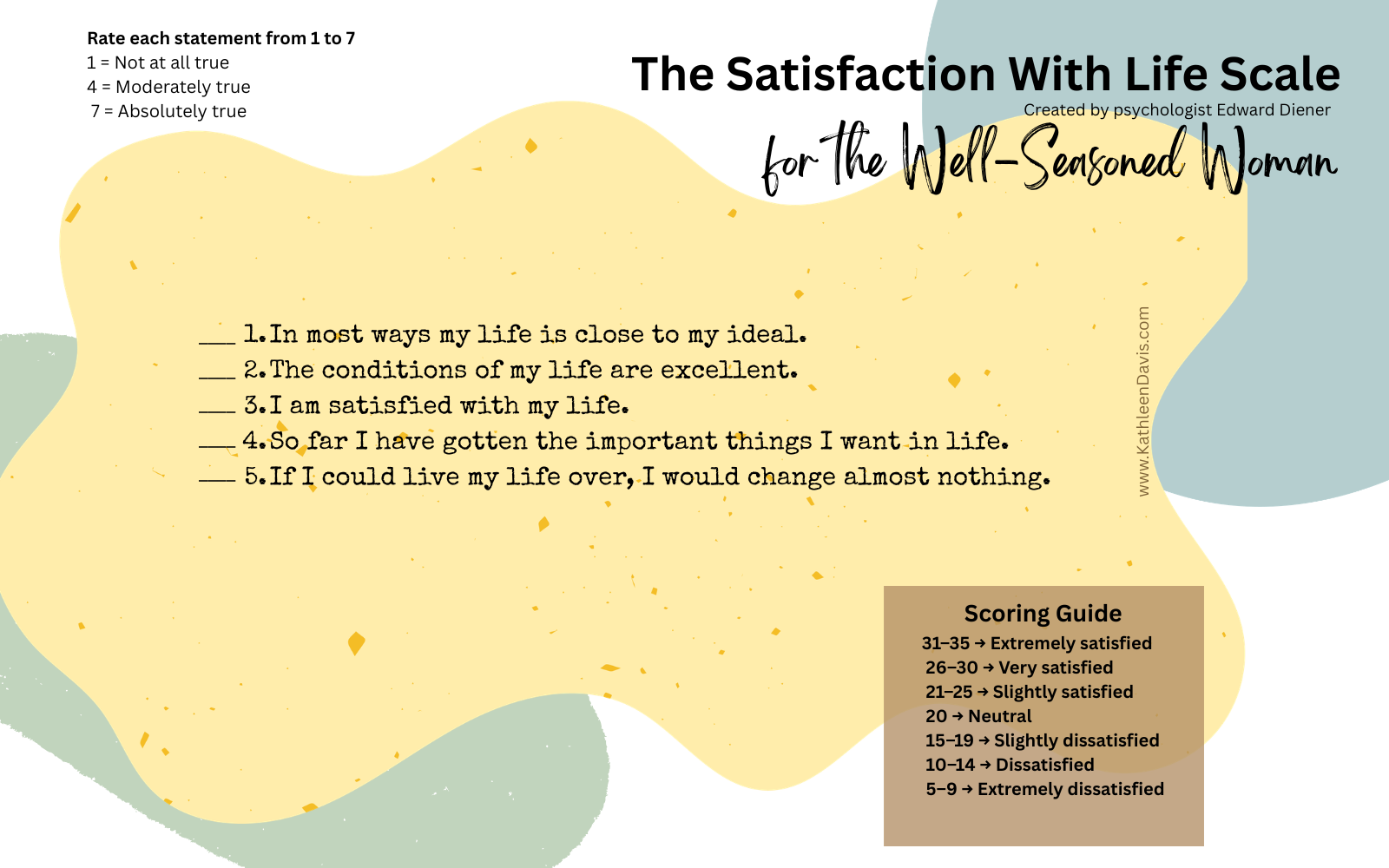
Researchers often measure life satisfaction using a short reflection called The Satisfaction With Life Scale, created by psychologist Edward Diener.
You might enjoy using it as a personal check-in every few years.
Try it on milestone birthdays—40, 50, 60, 70, 80—or even annually.
Rate each statement from 1 to 7
1 = Not at all true
4 = Moderately true
7 = Absolutely true
In most ways my life is close to my ideal.
The conditions of my life are excellent.
I am satisfied with my life.
So far I have gotten the important things I want in life.
If I could live my life over, I would change almost nothing.
Add your scores.
Scoring Guide
31–35 → Extremely satisfied
26–30 → Very satisfied
21–25 → Slightly satisfied
20 → Neutral
15–19 → Slightly dissatisfied
10–14 → Dissatisfied
5–9 → Extremely dissatisfied
Tracking this score over time can help you notice patterns and shifts in your experience of life.
It’s one more tool for getting clear.
The Well-Seasoned Woman’s Path Forward
Midlife isn’t just a passage of time.
It’s an invitation.
An invitation to step into the next chapter of life with intention.
In my work with women, I often guide them through four stages of this journey:
Get Clear
Understand where you are and what this season is asking of you.
Give Yourself Permission
Release outdated expectations and claim your right to grow in new directions.
Befriend Your Wiring
Learn how your unique brain, body, and emotional patterns work so you can cooperate with them rather than fight them.
Create a Life You Love
Design rhythms, relationships, and contributions that reflect the woman you’re becoming.
This is the work of becoming well-seasoned.
And the U-Curve reminds us that the climb upward may already be beginning.
So if you're somewhere in the valley right now, take heart.
You are not alone.
You are not behind.
You are standing in a very human turning point.
And if the research is right—
the view from the other side of the curve may be even more beautiful than the one behind you.
Here’s to all of us riding the ride of life together.